Tutorial
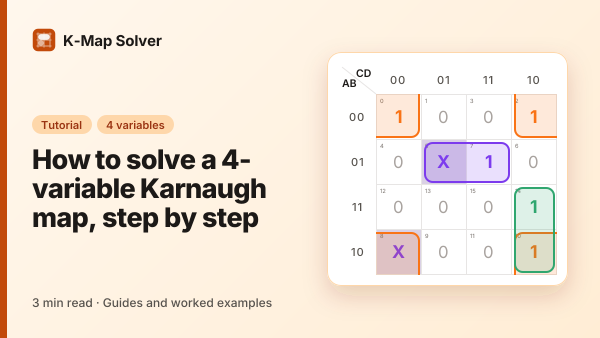
How to solve a 4-variable Karnaugh map, step by step
Sixteen cells, five habits: Gray-code layout, power-of-two groups, wrap-around, don't-cares and a final check.
· 3 min read
Short, worked-through explanations of the ideas behind the solver. Every example is solved by the same engine you can use on the home page.
Sixteen cells, five habits: Gray-code layout, power-of-two groups, wrap-around, don't-cares and a final check.
· 3 min read
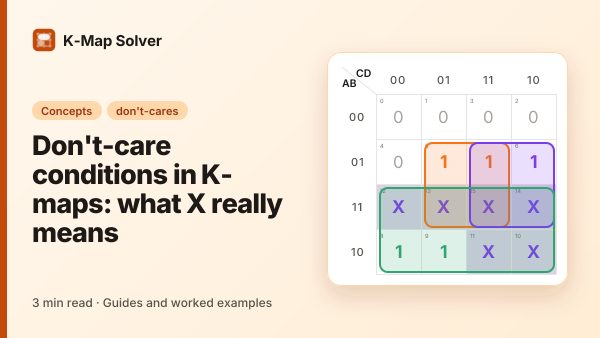
A BCD “greater than four” detector shrinks from nine literals to five when the unused codes are allowed to help.
· 3 min read
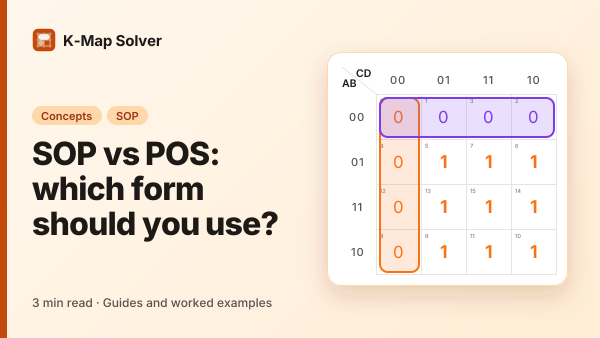
Both forms describe the same function. Count the zeros and the ones, then pick the one with less to cover.
· 3 min read
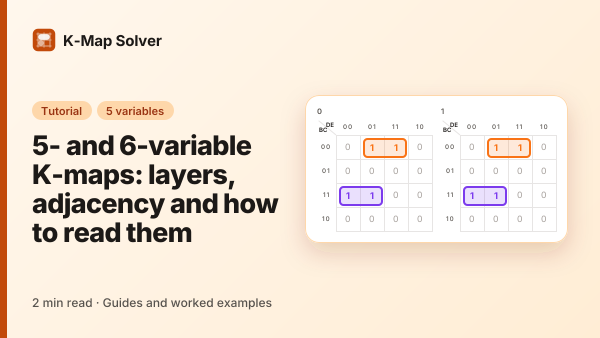
A flat map cannot keep every neighbour one bit apart, so bigger problems use stacked 4×4 layers.
· 2 min read
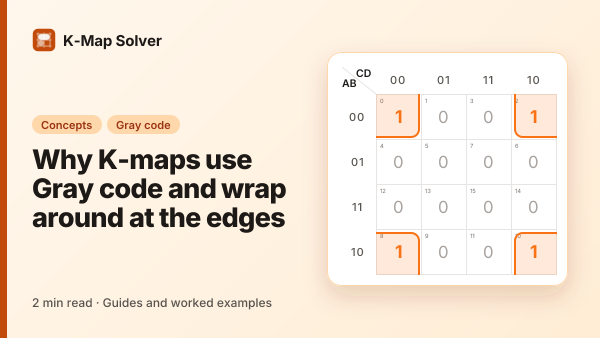
The odd-looking label order and the wrapping edges are the same idea: neighbours differ in exactly one variable.
· 2 min read
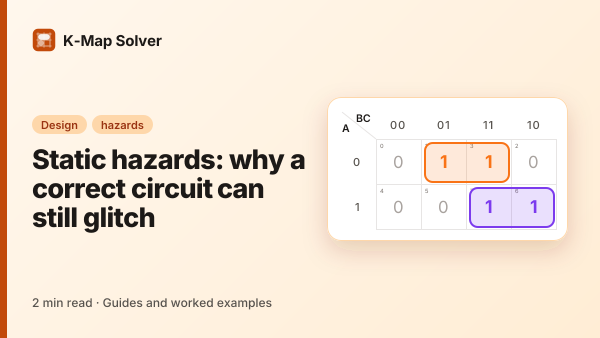
AB + A'C is minimal and correct, yet it can drop to 0 for an instant. One extra term fixes it.
· 2 min read
Prefer a feed reader? Subscribe by RSS.